Tight hips are one of the most common findings in people who sit for a living — and one of the most common contributors to low back stiffness. This five-minute routine is what I give patients to do in the morning, before the day loads the same tissues again.
Why do hips affect the low back?
The hip and the lumbar spine work as a unit. When the hips do not extend or rotate well, the low back tends to make up the difference, taking on movement it is less suited to repeating. Over time that shows up as stiffness, a nagging ache after walking, or discomfort standing up from a chair.
The five-minute routine
Move slowly and stay within comfortable range. None of this should be painful.
1. Knee rocking (1 minute). Lying on your back, knees bent, feet flat. Let both knees fall gently to one side, then the other. Small, easy, rhythmic.
2. Glute bridge (1 minute). Same starting position. Press through your heels and lift your hips until your body forms a straight line from knee to shoulder. Lower slowly. Ten to fifteen repetitions.
3. Half-kneeling hip flexor stretch (1 minute). Kneel on one knee, other foot forward. Tuck your tailbone under and shift weight gently forward until you feel a stretch at the front of the kneeling hip. Thirty seconds per side. Put a cushion under the knee.
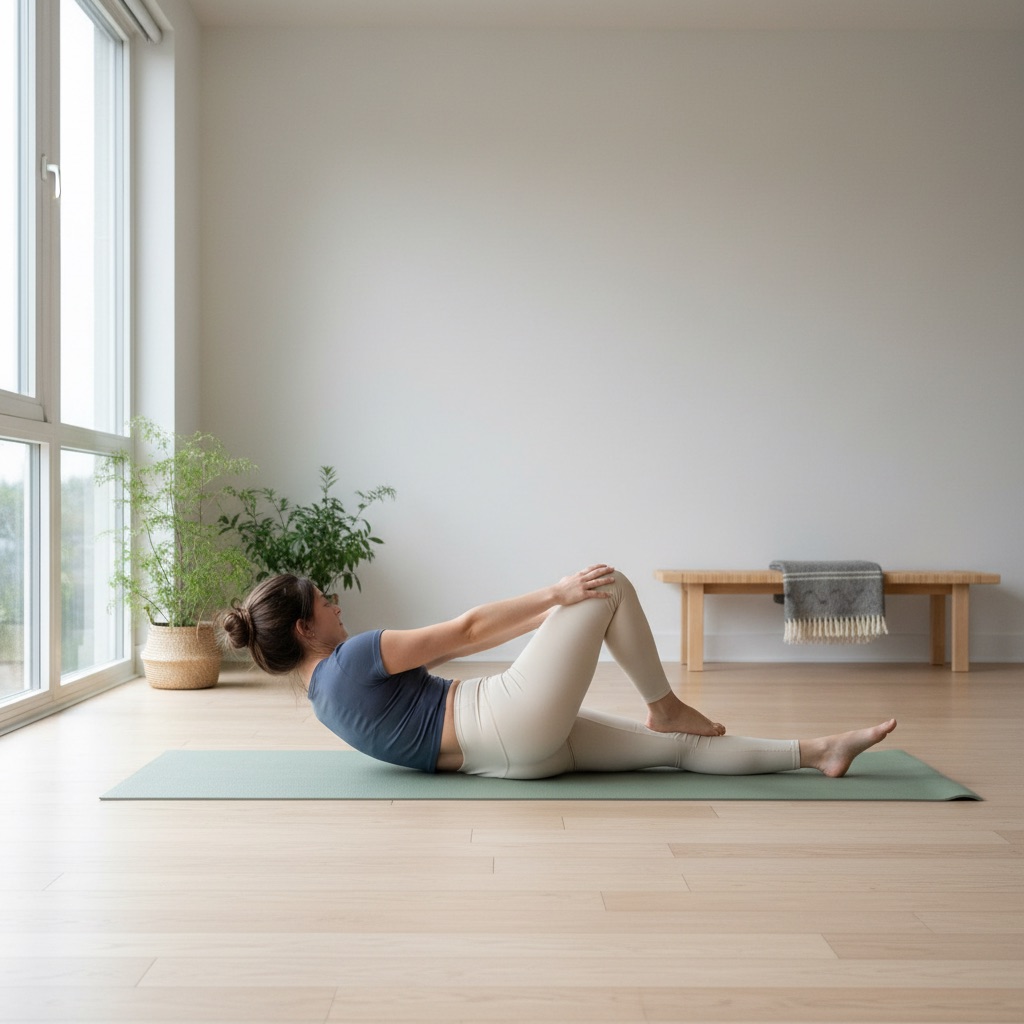
4. Figure-four stretch (1 minute). Lying on your back, cross one ankle over the opposite thigh and draw that thigh towards you. Thirty seconds per side. This targets the deep gluteal muscles.
5. Standing hip circles (1 minute). Holding a wall for balance, make slow circles with one knee, then the other. This finishes with active movement rather than static stretching.
How often, and how soon will it help?
Daily is better than occasionally. Mobility work responds to frequency more than intensity, and five minutes done most days will do more than a long session once a week. Most people notice easier movement within two to three weeks.
When stretching is not the answer
If a hip feels tight no matter how much you stretch it, the problem is often not muscle length — it can be a joint restriction, a stability issue, or pain referred from elsewhere. Persistent tightness, pain deep in the groin, catching or locking, or pain that travels down the leg should be assessed rather than stretched harder.